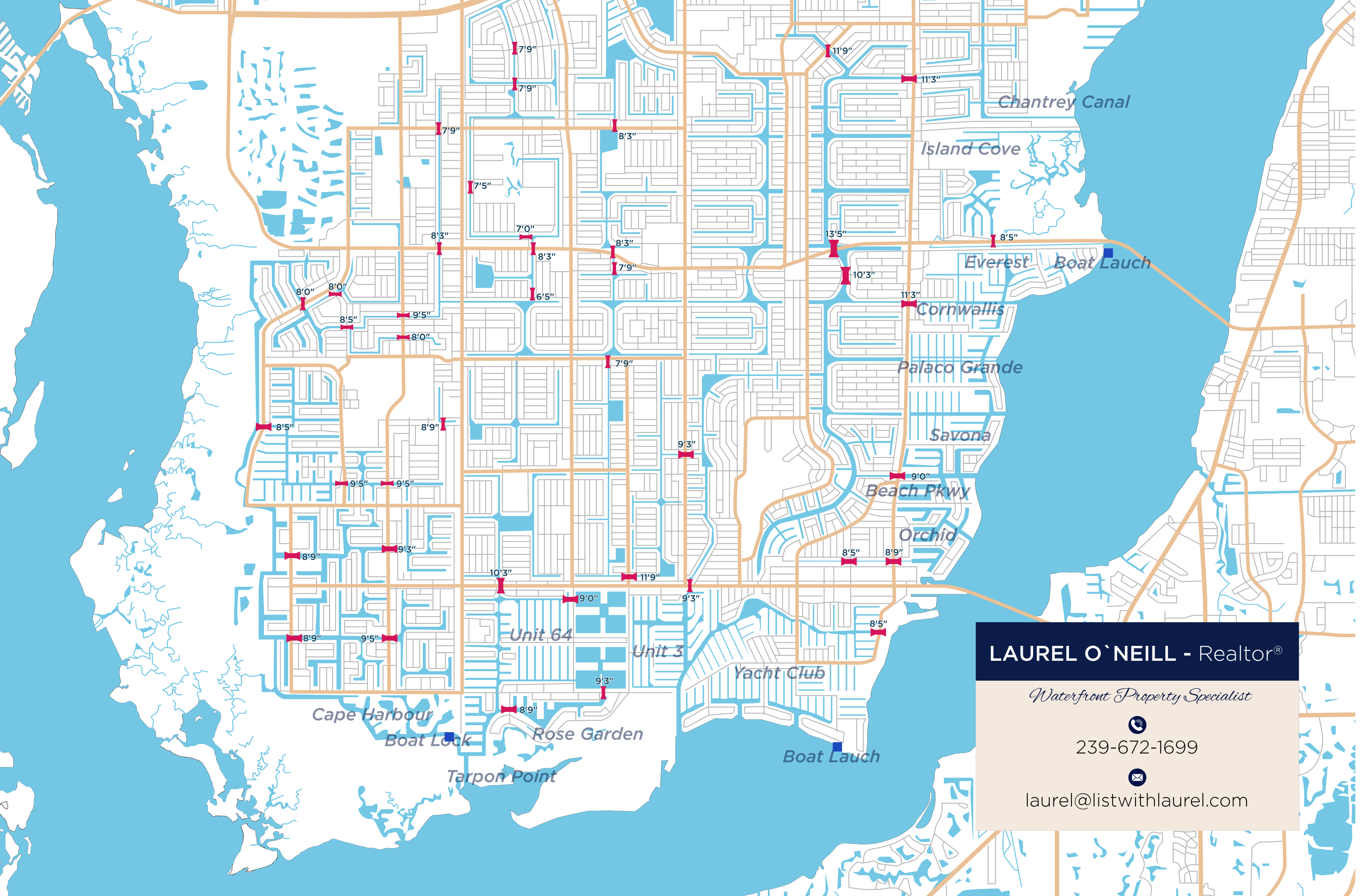
Cape Coral has more than 400 miles of canals, and many of them reach the Gulf of Mexico — but "Gulf access" is not the same as "your boat can get there." Fixed bridges cross the canal network at dozens of points, and each one sets a hard ceiling on the air draft (the height of a boat above the waterline) that can pass beneath it. The map below shows those fixed bridges and their clearances. Read it before you fall in love with a listing, not after.
What is the bridge clearance in Cape Coral's canals?
Across Cape Coral's mapped fixed bridges, clearances run from about 6 feet 5 inches at the lowest crossings to about 13 feet 5 inches at the highest, all measured at mean high water. On the main Gulf-access saltwater runs in the southern half of the city, most fixed bridges fall between roughly 8 and 11 feet. The most common clearances you'll see repeated across the network are in the 7-foot-9-inch to 9-foot-5-inch range. The lowest crossings — in the 6-to-7-foot band — tend to sit on the northern and more interior canal sections.
Source: List With Laurel Cape Coral bridge-height map, compiled from city canal data. Clearances are measured at mean high water and should be confirmed for your exact route before purchase.
| Clearance tier (at mean high water) | What it means for your boat |
|---|---|
| ~6'5" – 7'9" (lowest) | Tight for many powerboats. A bare-console skiff or low-profile bay boat may fit; most center consoles with a T-top will not. These crossings show up mostly on northern and interior runs. |
| ~8'0" – 9'5" (most common) | The typical Cape Coral Gulf-access band. Many center consoles, bay boats, and smaller cruisers clear comfortably; taller T-tops, hard-tops, and towers need to check the exact number on their route. |
| ~10'3" – 13'5" (highest) | The most forgiving fixed crossings. Larger cruisers and boats with significant superstructure have the best chance here — but still verify against your measured air draft. |
| No fixed bridge (direct / sailboat access) | The highest tier of access. Concentrated in the southeast quadrant, these routes reach the river with no fixed bridge at all — no height ceiling from a bridge. (Overhead utility wires can still apply; see below.) |
How do I use the bridge map to shop for a home?
Work the problem backward from your boat, not forward from the listing. Three steps:
1. Measure your boat's air draft. That's the height from the waterline to the tallest fixed point — usually the top of the T-top, hard-top, tower, or radar arch (antennas that fold down don't count). Add a safety margin. This single number is the constraint.
2. Trace the full route on the map, not just the nearest bridge. Find the property, then follow its canal all the way to open water and note every fixed bridge you'd pass under. Your ceiling is the lowest clearance on that entire route — one low bridge three miles away cancels out ten high ones near the dock.
3. Subtract the tide. The clearances on the map are measured at mean high water, which is close to the worst case. At low tide you gain room; during a king tide you lose it. If your air draft is within a foot or so of a bridge on your route, you'll be timing your runs around the tide — factor that into whether the home really fits your boating life.
Don't want to trace the map yourself?
Put your air draft into the checker and it'll sort your boat against every clearance tier on this page in one step.
Run the boat-fit checker →Why do bridge clearances change with the tide?
Cape Coral's Gulf-access canals are tidal — the water level rises and falls through the day, and the clearance under a fixed bridge rises and falls with it. The numbers on the map are measured at mean high water, so they represent close to the least clearance you'll have on a normal day. At low tide you have more room. During spring tides (around the full and new moon) and especially during winter king tides, water can run well above a typical high tide, and a boat that normally clears a bridge can find itself short. Boaters who run a fixed route learn to check a tide app before leaving the dock. NOAA's Tides & Currents is free and accurate; for route and depth planning, the Navionics app is the one I use.
Which Cape Coral areas have no bridge restrictions?
The southeast (SE) quadrant holds the highest concentration of direct and sailboat-access canals — routes that reach the Caloosahatchee River with no fixed bridge in the way. That's why SE Cape commands the highest waterfront prices in the city: for a tall boat or a sailboat, it's often the only quadrant that works. The southwest (SW) quadrant opened up considerably after the Chiquita Boat Lock was permanently removed on June 17, 2025 — boats that once had to wait for the lock now pass straight into the Southwest Spreader Waterway, though some shallow zones may remain while the city finishes dredging. The northwest (NW) reaches Charlotte Harbor and Pine Island Sound by a different route, and the northeast (NE) is freshwater only — no Gulf access at all. For a full breakdown, see the Cape Coral canal-types guide.
What should I verify before buying a Gulf-access home?
The map gets you to the right shortlist. Before you write an offer, confirm the specifics for the exact property:
The lowest bridge on the actual route, measured at mean high water, and how it compares to your measured air draft with a safety margin.
The depth at the dock at mean low water — the worst-case depth, not the average — so your boat floats on and off the lift at any tide.
Any shoaling or recent dredging on the route, particularly after major storms, which can quietly reduce real-world clearance and depth.
For sailboats and tall vessels, the overhead utility-wire clearances on the specific route, which the bridge numbers alone won't tell you.
Clearance is one of six things to verify
The map settles the bridge question. The checklist covers the rest — depth at the dock at mean low water, seawall and lift condition, flood zone and insurance, and five questions worth asking the listing agent out loud.
Get the Buyer's Verification Checklist →Clearance is half the answer — minutes are the other half.
Type any Cape Coral address into the new calculator and see the boat time to open water, the route on a map, and the lowest bridge on it.
Check minutes to open water →Two shortcuts
Current Gulf-access listings. A live, MLS-fed list of Cape Coral waterfront and Gulf-access homes. Browse today's Gulf-access listings →
Search every Cape Coral home. The full, live MLS — filter by waterfront, Gulf access, price, and more. See every Cape Coral home with boat access →
Or skip the map and just tell me your boat. Give me your air draft and draft and I'll tell you which canals work — 239-672-1699.

About Laurel ONeill — Cape Coral's Waterfront & Gulf-Access Specialist
Laurel ONeill is a SWFL waterfront and Gulf-access REALTOR® with Barclay's Real Estate Group (FL Lic. #3439451), serving Cape Coral, Fort Myers, North Fort Myers, Punta Gorda, Port Charlotte, and the broader Southwest Florida market — with additional coverage in Sarasota and Sebring/Highlands County. She specializes in canal hierarchy, bridge clearance, boat-draft compatibility, seawall and dock condition, flood zones, and post-Ian/Helene/Milton insurance realities.
Matching a boat to a canal is exactly the kind of technical question most listings gloss over. It's where I focus. 239-672-1699 · ListWithLaurel.com · More about Laurel →